


stop

ATOM
QUANTUM

POST-QUANTUM LAYER 1 · 2026

Audit in progress

A post-quantum L1 for the world after secp256k1

20 26
Scroll down

The threshold of Q-Day

Secp256k1 and BLS areno longer safe assumptions

Every major chain stakes its security on elliptic-curve cryptography that a large enough quantum computer breaks with Shor's algorithm. You can't patch a live network into post-quantum safety; you build the chain around the new primitives from genesis.

The name

What ATQM stands for

Atom

Technology

Quantum

Mainnet

A post-quantum Layer 1 for the worldA post-quantum Layer 1 for the worldafter secp256k1.after secp256k1.
NIST-standardized post-quantum primitives (FIPS203/204;NIST-standardized post-quantum primitives (FIPS203/204;FN-DSA draft FIPS 206).FN-DSA draft FIPS 206).
Cryptography resistant to harvest-now,Cryptography resistant to harvest-now,decrypt-later attacks from genesis.decrypt-later attacks from genesis.
HotStuff finality with ML-DSA / ML-KEMHotStuff finality with ML-DSA / ML-KEMat the core of every surface.at the core of every surface.

Three roles, one transport

Every node speaks the same encrypted transports

Every node speaks the same encrypted, ML-KEM-derived transport. Only the cargo changes.

atom-qant

Discovery: tANR records and peer discovery. No validator state, no execution data.

Public Execution: Finalized block sync, transaction gossip, snap-style state distribution.

Validator: HotStuff proposals, votes, quorum certificates, commits, and finality certificates.

ML-KEM-768 + AES-GCM + ML-DSA transcript binding

ML-KEM-768 derives the session key

AES-GCM provides AEAD with replay protection and epoch rekeying

ML-DSA signs the handshake transcript, blocking downgrade attacks

Post-quantum stack

NIST-standardized where it counts

NIST-standardized where it counts, named layer by layer rather than sold as a top-to-bottom sweep

Post-quantum cryptographic primitives by protocol layer
LayerPrimitive

Transaction
authentication

ML-DSA / FN-DSA

single-key or threshold-of-N

Validator consensus
signatures

ML-DSA

no BLS, no aggregation

Transport key
exchange

ML-KEM-768

all node-to-node transport

Transport AEAD

AES-GCM

replay protection + epoch rekeying

Node identity

ML-DSA + ML-KEM keys

bound in ATQMNodeId

Transaction model

Same EVM. Different signature. Cleaner surface

A Solidity contract that compiled and ran on Ethereum compiles and runs on ATQM; only the signing layer underneath changed

EVM-compatible

Nonce, chain id, gas, EIP-1559 fees, access lists, EIP-2718 envelopes, RLP. Solidity tooling carries over

PQ-signed

ML-DSA / FN-DSA replaces ECDSA on every transaction envelope. Same addresses, new signatures underneath

Same bytecode

A Solidity contract that compiled on Ethereum compiles and runs on ATQM. Opcodes, gas, and receipts stay familiar

Cleaner surface

Same EVM surface, different signing spine. Only the cryptography underneath changed — not the contract model developers touch

Performance

How fast is finalized?

Honest qualification: a 4-validator smoke run is a code-correctness signal, not a production benchmark. Behaviour at production scale (50+ validators, real geography, ML-DSA quorums without aggregation) is still to be tested. The round timeout is not the block interval; finality waits on real payload-build, proposal, vote-quorum, QC, commit-vote-quorum, and persistence time

< 1 s

Deterministic finality on a healthy network

300+

Blocks finalized end-to-end in smoke runs

4

Validators + full-client topology, verified

0

Probabilistic confirmations to wait through

ATQM WALLET

Spend. Send. Earn

Up to 4%

Cashback on every qualified purchase

Free transfers

Send money across borders for free and in seconds

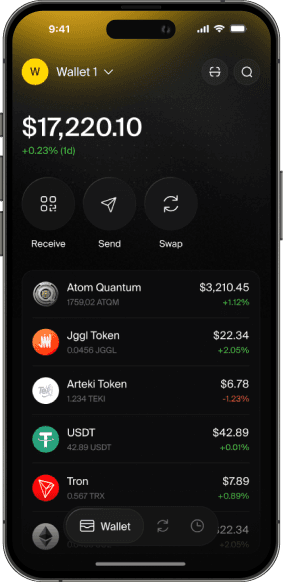
ATQM Wallet app interface on a smartphone

Up to 6%

Keep earning on your balance until you spend

180+ countries

Spend wherever Visa is accepted

One core, many surfaces

The ATOM ecosystem

ATQM is the post-quantum core. Trading, staking, bridging, and wallets all settle on the same ML-DSA / ML-KEM spine, so the surface a user touches can't weaken the security underneath.

Showing Dex, slide 1 of 4

Roadmap & wallets

From PQ L1 to consumer-grade wallets

ATQM is the post-quantum core. Trading, staking, bridging, and wallets all settle on the same ML-DSA / ML-KEM spine, so the surface a user touches can't weaken the security underneath.

ATQM

iOS & Android

FaceID / fingerprint unlocks a Secure Enclave / StrongBox-isolated worker. The PQ key never leaves cleartext.

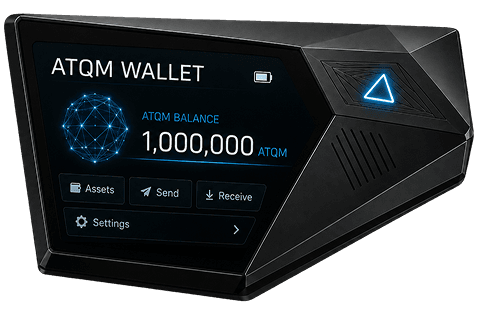
ATQM wallet devices

Browser extension

MetaMask-shaped EIP-1193 provider plus a native atqm_* surface for PQ signing and order types

Hardware path

Paired-mobile QR handoff today; native ML-DSA firmware on Ledger / Trezor when vendors ship it

Roadmap

Q1–Q2 2026

ATQM is the post-quantum core. Trading, staking, bridging, and wallets all settle on the same ML-DSA / ML-KEM spine, so the surface a user touches can't weaken the security underneath.

atqm network

ATQM rebuilds Ethereum's execution stack on NIST-standardized post-quantum primitives. It replaces every signature, key exchange, and consensus message, runs HotStuff finality instead of Gasper, and keeps a decade of Reth engineering.

EVM where it counts. New cryptography everywhere else